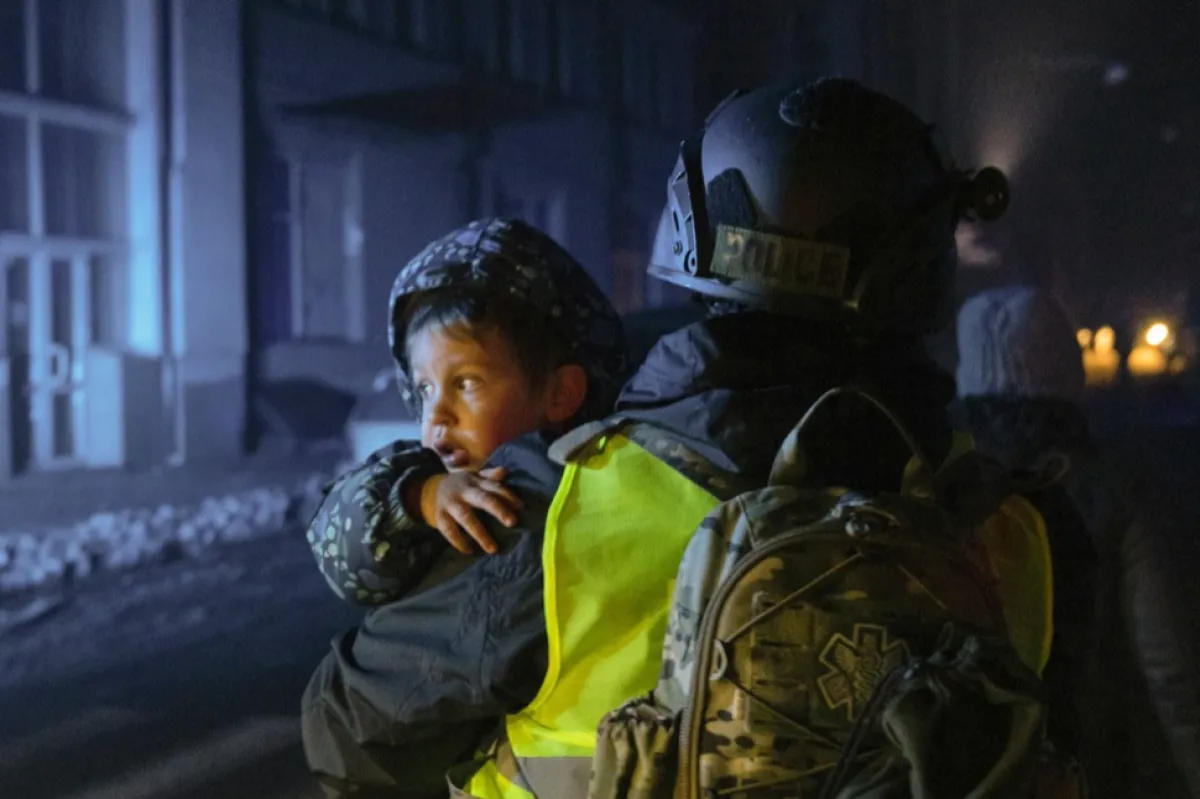
Kharkiv has been a target for the Russians ever since the war broke out, and in recent weeks there have been widespread rumors the city might witness a new land attack, similar to the one over February- March 2022. The inhabitants of the second-largest city of Ukraine located close to the Russian border refuse to leave and try to carry on with their lives and preserve some sense of normalcy, despite the constant shelling. Tatsiana Ashurkevich describes what she saw during her latest visit to Kharkiv.
“If they’re thinking we’re going to greet them with bread and salt, they’ve got another thing coming!”
The train taking me from Kyiv to Kharkiv arrives at the station at 6 AM. The city lies dormant, save a few early risers who cross the square in front of the station in a hurry. I came here as a journalist, and I’m wearing a 12-kg bulletproof vest and a helmet. While I’m waiting for my ride, I see five men walking by, one or two at a time. They’re all smiling, and I decide to stop one of them to ask why.
“Ever since the full-scale invasion broke out, I have never seen anyone wearing a helmet. You’ll be the only one wearing one here”, 43-year-old Gennady tells me, lighting a cigarette. “Sorry to have to tell you this, but that won’t really work: missiles hit Kharkiv in under 47 seconds. You should pray instead – you’ll find it more useful”.
Only later did I discover that people relate to death with humor and acceptance. New arrivals might find this shocking, but it seems to be the only way to keep your wits about your around here due to overbearing stress. This is the first thing that strikes me about Kharkiv upon arrival, completely at odds with the “peaceful” Kyiv.
“Fear was the first thing we experienced when the Russians started to bomb the northern cities. But now…as you know, we’ve grown used to it. You’re alive and well – you should enjoy that while it lasts”, says my taxi-driver, Aleksandr, a 50-year-old man who smiles at the sight of my military gear while helping me load my luggage in the back of his car.
“But you put your life and health at risk every day. Haven’t you considered leaving this place?”, I ask.
“Leave? Leave Kharkiv behind?”, he says as he touches my bulletproof vest. “Miss, this is not a city that would surrender. If they’re thinking we’re going to greet them with bread and salt, they’ve got another thing coming! They need people to support them, but our people will never forgive them for all the lives they’ve taken”.
The morning Aleksandr drives me to my new home was shiny and calm – people were going to work, all business as usual. A group of nice old ladies were wondering when the local store is going to get fresh supplies of salami. One man was furious about his door lock getting jammed. When you’ve grown up in ex-Soviet space, such images will only trigger your nostalgia for your childhood years. It doesn’t even feel like there’s a war. “You’re being lied to”, is what Russian propaganda keeps telling people. You get this sense that, if you’re lucky enough, you might get a one-and-a-half-hour break from the air sirens in this city. Sadly for the propagandists, a casual walk around downtown Kharkiv will immediately unravel their deception.

@Liashenko Yakiv
“They’re shelling us all the time. We’ve already grown used with the idea of dying”
The presence of war can be felt at every step, everywhere. Nearly all the banners and billboards you see are now dealing with military topics: women on the phone discussing their husbands’ problems with the recruitment office. A man in military uniform gazing at the blooming lilac. Evidence that this is merely a semblance of normality are the windows of the buildings in the city center. Very few are still intact. Others are cracked, covered up with sheets of aluminum. The rest are all boarded up with wooden or chipboard planks. Their appearance speaks to Russian missile and drone attacks or KAB bombing. Nearly every building is destroyed, torn apart or bearing the marks of shrapnel and shockwaves. “This is where a mother and her child were killed”, “this is where a man went out the balcony for a smoke and died”, “here’s where the rescue teams were blown up” – every dent in the brickwork, concrete and pavement has a painful and bloody story to tell. Hotels, cafés, pastry shops, residential buildings and parks – they have all become “strategic targets” for the Russian army.

@Liashenko Yakiv
Sergey lives across the street from an apartment building that was razed to the ground in a Russian missile attack on January 23. The photographer and I approach him while he’s having a smoke with a friend.
“My dear, do you honestly believe this was the only time this happened? It’s raining bombs here all the time. We’re already used to death. At four in the morning, the bombs dropped on the building next to ours: the blast blew out all the doors and windows. A total of 11 people were killed, including two children. The explosion didn’t impact our building and, thank God, we live to see another day. We even went to work the next morning”. “Hey, did you hear that? It's always like that around here”, says a man pointing to the border with Russia. A few moments earlier we’d heard two muffled explosions on the horizon. “My cousins live in Belgorod, but that means nothing to me right now. And if someone does decide to come here, I can fight back. Our army, on the other hand, has nothing to defend itself with: so many of our boys have already died! The Europeans could at least give us weapons, or better yet, anti-aircraft defense systems, so we don't have to hear ‘this’ every night”.

@Liashenko Yakiv
Indeed, “this” is something that happens in Kharkiv and its outskirts almost on a daily basis. Missiles reach the city within less than a minute, and when the air raid sirens go off at night, you would have to be a sprint runner to find shelter. Adjusting to wartime living is possible only three days later, with announcements of “ballistic threats” keeping you awake most of the first two nights. First, you move your bed into the bathroom, to observe the “two-wall rule”, checking your phone each time you hear a new call for vigilance outside. The third night, the dark circles under your eyes force you to get earplugs. You turn off your phone and you finally get some shut-eye, in a normal bed. When your energy levels get low, the choice between worrying constantly and accepting death comes a lot easier than it might seem. It becomes even more obvious when people live under these circumstances for years.
Life under Russian shelling: electricity and water rationing, the constant buzz of generators and schools operating underground
Kharkiv dwellers have to cope with more than these nocturnal terrors: aside from the grueling nighttime attacks, people must also adapt to electricity and water supply timetables. A fully charged power bank is a must-have here: there’s simply not enough power to keep your devices operational. In recent weeks, the Russian army set out to destroy Kharkiv’s thermal power stations, one of which was blown to smithereens. This is why the buzz you hear at every street corner is reminiscent of a perpetual motion machine: there’s a generator by the entrance of each coffeeshop, and having a conversation on the street can be a real challenge. Most traffic lights are out of order, which means there’s a traffic warden in every junction. At night, Kharkiv sinks into utter darkness: the only lights on the street are the coffeeshop signs. Bedroom districts and parks are downright depressing: finding your way around without a flashlight is virtually impossible.

@Liashenko Yakiv
Present-day electricity shortages are just the beginning, says the deputy head of the Kharkiv military administration, Yevgeny Ivanov.
“We have 300,000 subscribers who don’t have electricity around the clock. It will take us many years to be able to restore electricity supplies to normal levels. Right now, the entire activity of hospitals, public transport and state institutions is adapted to the constant power cuts”, Ivanov says. “People adapt, but I’m terrified at the thought of what we’re going to do come the cold season”.
Schools find it particularly hard to stay open under these circumstances, which is why the city hall decided to set up schooling areas in subway stations. Sheltered from outside bombings, pupils from the first to the eleventh grades try to keep up with school curricula. On a regular workday, classes are held in two shifts.

@Liashenko Yakiv
The long rooms are soundproof, so that children cannot hear the air raids or get frightened by the bombings. There’s a psychologist in addition to a teacher in every school room, in case someone needs that kind of assistance. Overall, there are 56,000 pupils in Kharkiv, 2,200 of whom study in underground schooling units. Tatiana teaches fifth grade. She believes it’s important that children come out here to socialize.

@Liashenko Yakiv
“We have few children who’ve had a near-death experience or who were at the center of an explosion. For the most part, parents keep them safe. When these bombings started a couple of years ago, parents used to live with their children in our school shelter, trying to distract the kids lest they should hear the horrors outside. You should know that, in the end, it was children who ended up soothing their parents”, the woman smiles bitterly.

@Liashenko Yakiv
Despite the bombings, people won’t leave: “this is our home”
It’s not just schools that have to cope with adversity. Companies that reopened for business after the Russian troops were driven away from the city are also forced to adapt.
The coffeeshop where we stop for lunch is powered by a generator. Its owner, Ryna, says it’s not easy for them to stay open: the entire activity of the coffeeshop is electricity-based. Besides, a missile recently hit the building next door, and the shockwave reached Ryna’s coffeeshop, blowing out its windows.
“We’ve had new windows installed, and all the money was raised by our friends, people we know and clients”, Ryna says. “From a financial point of view, life is very hard. But for the city to stay alive, someone needs to keep working. What happens when everyone closes shop? I’m not being dramatic or patriotic, but this is simply our home. This is where our friends and parents live. When you have so much that matters for you going here, you can’t just leave everything behind and go. You’ll try to turn your life around to protect whatever you have left”.
As we chat, the air raid sirens go off again. The reaction is the same for everyone – indifference.
“I noticed people here no longer go down to bomb shelters. Is it because they’ve grown accustomed to the bombings?”
“It’s not that we wanted to get accustomed to this state of affairs, that’s for sure. But there’s simply no other alternative for us. Maybe if something is directly targeting Kharkiv, people will react…if they get the chance”.
You can check out the trajectory of missiles with special chatbots. Valya and Iryna are sitting at a table on the terrace and continue their conversation pretty much ignoring the blaring sirens and their cellphone pings. Valya is an artist. She says a lot of young people have stayed behind despite the constant threats.

@Liashenko Yakiv
“When panic started to grip the city, I moved to Poltava for a month, a city where bombings were less frequent. But I felt like something was physically pulling me back. If all the young artists leave the city, then our culture will just die. For the city to live, there must be young people here, to uphold Ukrainian creativity and culture”, the girl says. “Otherwise, this city will be nothing than mounds of concrete, which are no longer worth fighting for”.
“Are you willing to accept that this is what your life will look like hereon out, living with constant bombings and blackouts?”
“When the power goes off, you check the online map to see where the power is still on, so that’s where you go. At any rate, what you see now is a vibrant city. But back in February 2022, there was nothing here except explosions, rundown buildings, closed coffeeshops and empty streets. All my friends are now back: they all want Kharkiv to live again. But for that to happen, you need people to keep things going”, Valya says.
I can hear children giggling from the playground next to the coffeeshop. 30-year-old Alina is playing with her daughter. She stops to chat with me, just as the air raid sirens start blaring again. Alina takes her daughter’s hand, but she keeps talking to me.
“Leave? No, I couldn’t. My husband is here, he’s all the family I’ve got left. How could I ever abandon him? And go…where? I would need money for that, a whole new place to live. Where are we supposed to find that?”, the woman sighs. “We’re reconciled to the risk we’re taking, although there’s a chronic fear constantly gripping us. We do what we can: I have two kids, and my husband and I only take them out through backyards. When the bombs start dropping, we tell them it’s thunder. We keep them calm the best we can. I’m confident the Russians won’t get to Kharkiv. They will sooner keep bombing us – that’s the fate of a borderland city”.
Here, in downtown Kharkiv, life goes on against the backdrop of bombs exploding. I get the same explanation from pretty much everyone I ask: “We need to keep working”, “We need to feed our children”, “Leave? Where, exactly? Are we expected somewhere we don’t know of?” The locals try to convince me adjusting to their new living arrangements is still hard on them: “You can’t possible get used to something like that”. To people who’re not from around, their behavior is striking. But that’s the new Ukrainian “normality”.

@Liashenko Yakiv
-
“You’re surprised, because this is merely your second day here. But we’ve been living like this for three years. Look at the houses in Saltovka, they all look like strainers. You should go see what the “liberators” did to our neighborhood. There were families with children living there”, says 60-year-old Natalia, who sells jewelry on the street. The woman speaks calmly, but with every sentence her voice starts to screech, tears welling her eyes.
Natalia was mentioning Saltovka, the biggest residential district, not just in Kharkiv, but in Ukraine as a whole. As many as 400,000 people used to live here. Starting February 2022, most of the Russian missile attacks targeted this very neighborhood. As a result, over 70% of residential buildings and infrastructure have been destroyed, and the number of inhabitants, according to some estimates, dropped to a thousand people. Although Ukrainian armed forces succeeded in repelling the Russian land attack, most houses are now like a scene from a post-apocalyptic film. A bunch of old ladies say the Russians bombed Saltovka with every weapon at their disposal – which they seem to know better now than the very seeds they buy at the vegetable market.

@Liashenko Yakiv
Eye-witness accounts from Kharkiv’s ghost-neighborhood: “It hit me so hard, that I forgot the names of the people I used to know and the multiplication table”
The harsh realization you are this close to the Russian border seems to sink in and weigh down on you with each step taking you closer to Saltovka. Old garages, ravaged by shells and shrapnel, high-rise buildings with black smudges instead of windows and balconies, piles of concrete which once served as staircases. There are signs on both signs of the road, inscribed with one word: “Mines”. The farther you go, the more you see them, in addition to servicemen and checkpoints, and the louder artillery and missile fire gets.
The ruins of school no. 134, which is where Russian troops took shelter and were eventually destroyed in the early days of the battle for Kharkiv, are now living proof of those violent clashes.
A pile of rubble is all that remains where the school once stood, and this is not an isolated case. Everywhere you stop, there are high apartment buildings with overhanging woodwork that risks falling at the slightest gust of wind. The blocks that used to house residential buildings are now filled with pieces of charred furniture. The top floors now serve as nesting grounds for birds. Playgrounds once roaring with laughter are now deserted. All courtyards look the same: you can tell them apart only by the extent of their ruin.

@Liashenko Yakiv
Basically, no one lives here anymore, although according to the authorities, some people have started to return after certain villages were liberated. Those who do come back are elderly people, who lack the financial means to find a new home. Thus, some of them decide to take refuge in one of the many houses that were destroyed and are nearly uninhabitable. It’s what Olga did too.
In March 2022, a shell hit her home. Her neighbors had taken refuge in the basement, and when the bombing seemed to settle, people started getting out. That’s when a missile exploded in front of the building. Five people were killed, and Olga was hurt by the shockwave.
“It hit me so hard, that I forgot the names of the people I used to know and the multiplication table. God forbid you should ever experience something like that. You just see the tail of the missile on fire, flying silently, and the next thing – bang, you’re down”.
Olga spent three months in the hospital before coming back. She very seldom speaks about the war, preferring to chat about other stuff, that might seem trivial in the given context. It’s like she’s talking to herself.
“I used to have 80 rose bushes, here, on this side, and over there too. Now, there’s nothing left. I used to have dozens of shelves filled with books, but the moisture got to all of them…”
“What about your apartment? Has it been destroyed”, I dare ask.
“Of course, bomb shrapnel perforated the ceiling. The heat pipe was punctured. The bombs blew the furniture into little pieces. My windows overlook the other side of the building, so at least the walls of the apartment still stand. I got the heat pipe fixed. In September, they restored the gas line, and in December the power came back on. However, it’s just me living in the entire building. Everyone else is gone, they’re scattered now. How am I supposed to follow young people? I’ll be over here, waiting for my son to come back home when the war’s over. Praise the Lord, at least he’s still alive”.

@Liashenko Yakiv
Aleksandr’s building shared the same fate. He’s a fitness instructor, living two blocks away from Olga. The staircase of his building burned from the fifth floor to the ninth. It’s just a pile of black blocks with old bathtubs. You can actually spot the lower floor through the holes in the ground.
“When the shelling started, my wife and I managed to leave Saltovka to stay with our relatives. At the same time, we both wanted to get back to the neighborhood where we’d lived ever since the 90s. Now, we’re trying to put our apartment back together. It’s just the two of us living in the building: very few people want to return to an apartment without running water, gas or heating”, the man says.

@Liashenko Yakiv
Asked how he feels towards the Russians after everything that’s happened, Aleksandr waves off the question and swears. Everyone speaks very ill of the neighboring aggressor today. It’s hard to find anyone left in the city who feels different when asked this sort of question. People before used to be less apprehensive towards the Russians, city dwellers say. Nowadays, everyone wants them dead. It’s strange to expect any other type of reaction, when air raids eat away at your life systematically. Ballistic missiles, KABs and drones are now part of daily routine. And the 47 seconds required for a missile to hit the city might seem too brief a moment to waste looking for a place to take cover.
All these life-consuming experiences that Putin has blessed the inhabitants of Kharkiv with seem to have slightly subsided in the third year of war. But it makes no difference: if the Kremlin hoped the city would tire and surrender to Russian soldiers, it won’t be the first time it’s mistaken. For the time being, it seems Russia will have to face the opposite: hatred caused by the killing of family, friends and neighbors surges with each new attack. Proximity to Russia is also a negative: “There’s no forgiveness for everything we’ve been through”. Obviously, to right their wrongs, both Russia and the co-aggressor, Belarus, must make a colossal effort. How long is that going to take? It’s unclear. One thing is certain: it won’t be Putin, Lukashenko and their acolytes doing it, but a different group of people.