After over a decade of near total domestic political dominance, Hungarian Prime Minister Viktor Orban is having an unusually bruising 2021. The newly-formed United Opposition alliance gained a narrow lead over his Fidesz party in January and is still polling level. On March 3 Fidesz was forced to quit the centre-right European People’s Party EU group that it had called home for over two decades. Now, as the highly infectious British coronavirus variant rips through the country, causing 90% of the new cases, Hungary finds itself in the middle of a devastating third Covid wave.
Faced with a spike in Covid cases, Orban is turning for help to China and Russia
Hungarians have endured strict 8pm- 5am curfews since November 11, with soldiers patrolling the streets and the wearing of masks compulsory around larger towns. In spite of these strict measures, however, as of Monday March 22, Hungary topped the Covid deaths per capita rankings, at 19.37 people per million, or around 200 daily confirmed daily Coronavirus mortalities. State media reported that 11,276 are currently hospitalised in Hungary - 1,340 of them on ventilators - while 188,525 are actively infected with the Coronavirus.
Meanwhile, and somewhat counter-intuitively, the country is currently placed second for vaccination rates in the EU, having administered first jabs to just under 1.6 million, or 16% of the population, according to Hungary's chief medical officer Cecilia Muller. However Orban, who says he started to look for extra-EU vaccine options in November, appears to be setting Hungary on course for another major fall-out with the European Union.
The crux of the problem is that the Russian Sputnik and Chinese Sinopharm vaccines have not been approved by the European Medicines Agency (EMA) unlike the Pfizer, Moderna and AstraZeneca jabs which the EMA has declared safe for use in EU member states. Orban’s move eastwards in search of vaccines could also wreak havoc with the planned EU “Digital Green Certificate” passport, as Hungary has ceased including the vaccine manufacturer on certificates issued to individuals on receipt of a jab. Unbowed, Fidesz has announced that “on the basis of reciprocity Hungary will not accept the certificates of countries which do not accept those of Hungary”. Then on Monday March 22, the National Institute of Pharmacy and Nutrition (OGYEI) cleared another two non-EMA-approved vaccines, the Chinese CanSino and Covishield, developed by AstraZeneca and Oxford University, making Hungary the first country in the world to accept seven varieties.
From “Russians go home” to Putin’s Trojan Horse
Orban who, in an epochal speech in Baile Tusnad in 2014, cited China and Russia as model countries for “parting with Western European dogmas… to make us competitive in this great global race”, has long been accused of serving as Russian President Vladimir Putin’s “Trojan horse” within the EU. Hungary has not only let the controversial International Investment Bank relocate to Budapest and but has also agreed to Russia funding and carrying out the expansion of Hungary’s only nuclear power station in Paks. The Hungarian premier has not yet been made to pay at the ballot box for his volte face on Hungary’s former occupying force - from his famous “Russians go home” speech in 1989 until his return to power in 2010, Orban was extremely fond of anti-Russian rhetoric - but the locked-down Hungarians are increasingly restless, and largely remain wary of Sputnik V.
Orban may enjoy the more transactional nature of doing business with partners outside the EU, but these deals are not always good news for Hungarian taxpayers. Not only did the country pay 50 times the per kilogramme rate that Germany paid for ventilators and associated equipment from China last year, but his Eastern vaccine suppliers may now be receiving preferential treatment in return for promises of Sinopharm and Sputnik V. On March 13, the Hungarian State Railways Company MAV reportedly cancelled a tender to provide carriages as part of the revamp of Budapest’s suburban rail line HEV. Hungarian investigative website Direkt36 wrote that the 550-million-euro bidding process called in the autumn will now be relaunched as MAV has claimed that the respective bids of Swizerland’s Stadler and its Polish subsidiary, and the Italian subsidiary of France’s Alstom, were too high. This could clear the way for Russia’s Transmashholding, which won a tender to provide metro cars for Budapest’s M3 metro line in similarly murky circumstances in 2015. “Nowadays, good relations with Moscow are of particularly high importance for the Orban government due to its Sputnik V vaccine purchases from Russia,” Direkt36 commented.
The top diplomat moonlighting as a Sputnik V PR
Facing strong local reluctance to the Sputnik V vaccine in December - at least one poll put the Hungarian populace’s openness to the jab at just 7% - Hungarian Foreign Minister Peter Szijjarto claimed that "the vast majority of Hungarians have been vaccinated with Russian vaccines since childhood… all of our vaccines came from there." However, this is untrue, according to Amerikai Nepszava. The US-based Hungarian-language website recalled that before 1989, Hungarians were treated with Hungarian, not Russian vaccines, and none of the raw materials were sourced from the Soviet Union. “Fifty years ago, the licensing process was quite different, and the Soviet Union, in spite of all the horrors of the dictatorship, was a thousand times more reliable than Putin's mafia state. The comparison is not justified, even if Szijjártó had told the truth. But Szijjártó is lying,” Amerikai Nepszava wrote.
In the face of suspicion at home and abroad, Szijjarto went out to bat for the Hungarian government - and Sputnik V - in Moscow over the weekend. Prior to his interview with the Russian state-funded television network RT on Sunday, March 21, Szijjarto posted a photograph of his inoculation with the Sputnik V vaccine on Friday evening. Then, the same photo was tweeted by the Russian Foreign Ministry on Saturday morning, accompanied by the hashtag #RussiaHelps. The following evening the Kremlin’s international TV channel RT ran the same photograph above a story headlined “Hungarian foreign minister becomes first EU politician to take Russia’s Sputnik V, gets vaccine live on camera.”
Szijjarto spoke enthusiastically to RT regarding the Sputnik V vaccine he had received two days earlier. “I had not felt anything neither during vaccination nor after it. I received the first shot in the evening of Friday, so I can tell you that so far so good,” he added. “More than 1.5 million Hungarians have already been vaccinated and this would have not been possible if we had not decided to buy vaccine also from the East. Vaccine is not a question of ideology for us, it’s a matter of saving lives,” he said, adding that “a huge mistake which was committed in, let’s say, other parts of Europe, was that a question of ideology was made out of the issue of the vaccines.” Despite Szijjarto’s repeated accusations of the EU displaying “double standards”, Hungary declined to use its veto at the European Commission (EC) when it approved sanctions over abuses in China, Russia and Myanmar on Monday.
Sputnik V has meanwhile been aggressively promoted on social media sites such as Facebook and Twitter throughout March. Increasingly desperate Hungarians may now be willing to take the vaccines, despite their general lack of trust and the travel complications they may cause further down the road. Around half of the Covid shots so far administered in Hungary have been either the Sputnik V or the Chinese Sinopharm vaccine, and the country is now reportedly set to receive around 700,000 additional doses of Sputnik V in the next two weeks, according to Szijjarto.
As to why the Hungarian rates are the highest in the world, despite the strict lockdown stretching from late autumn into the spring: these may be partly down to a loophole in the system. If one claims to be gathering - or even travelling abroad - for reasons of business, then parties of up to ten are allowed to convene, with letters of permission from their employers. Just like Orban himself, the wealthier Hungarians’ love of a loophole may be one of the causes of the country’s current agonies, while others are left to pay the price. Another misstep has been a lack of any “home office” policy for Hungary’s vast civil service until the law was finally changed on March 5 to encourage civil servants not directly working on Covid-related matters to stay home when possible.
Business with China comes at a steep price
While Orban’s Russian dalliance is well documented, his increasing proximity to China has gone more under the radar. However Budapest is set to host Fudan, the first Chinese university campus to be established abroad, from 2024. Coupled with the projected high-speed Chinese freight railway link between Thessaloniki and Budapest, the Hungarian capital may become the key CEE hub for China. Accordingly, Szijjarto has not been the only Fidesz politician to “take one for the team”. When the first 550,000 of the five million dual-shot vaccines ordered from China arrived in Hungary in mid-February, Sinopharm ranked last in popularity behind the three EMA-approved Western vaccines - Pfizer/BioNTech, Moderna, and AstraZeneca vaccines, with Sputnik V in fourth place. Moreover a politician from the opposition Democratic Coalition party called Hungary paying 35 times more for Sinopharm vaccines than the USD 2.50 EMA-approved AstraZeneca jab “an eerie reminder of the case of the Chinese ventilators still collecting dust in our warehouses”. When details later emerged that a former Ferencvaros hockey player with no medical background had been used as a middleman for the purchase, Fidesz faced further accusations of vaccine-related corruption.
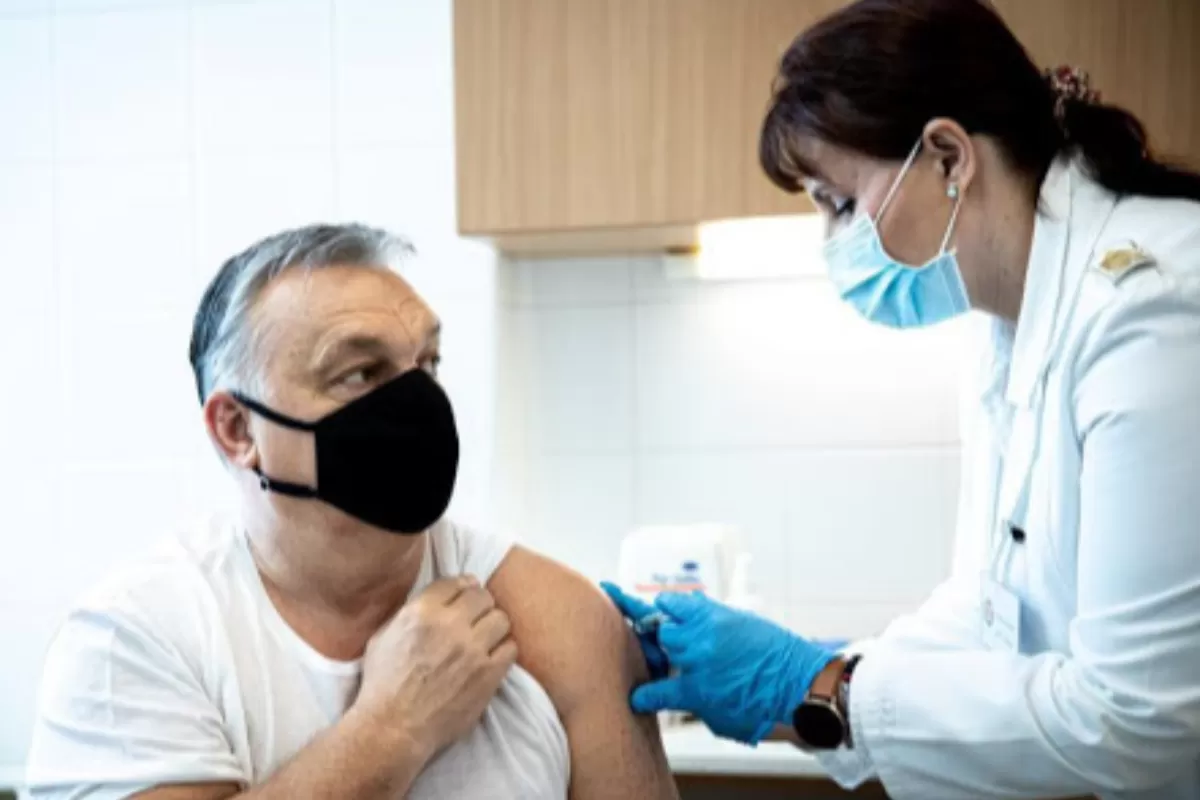
Citing a lack of information on Sinopharm, the Hungarian Medical Association (MOK) said at the beginning of February that it was "unable, in all conscience, to recommend the use of this product to its members". However the OGYEI ignored MOK’s concerns and, after 3,000 paid volunteers had received two jabs, Hungary began using Sinopharm without EMA authorisation, on February 24. Two days later President Janos Ader was filmed receiving a Sinopharm jab. On February 28, Orban's official Facebook page posted a series of photographs of the Hungarian premier getting jabbed, with the caption "I am vaccinated”. Orban called on Hungarian citizens to overcome their reservations about the Chinese vaccine in a video that ran on several government-friendly media outlets. "Without the Chinese and Russian vaccines, we would have big problems," he said.