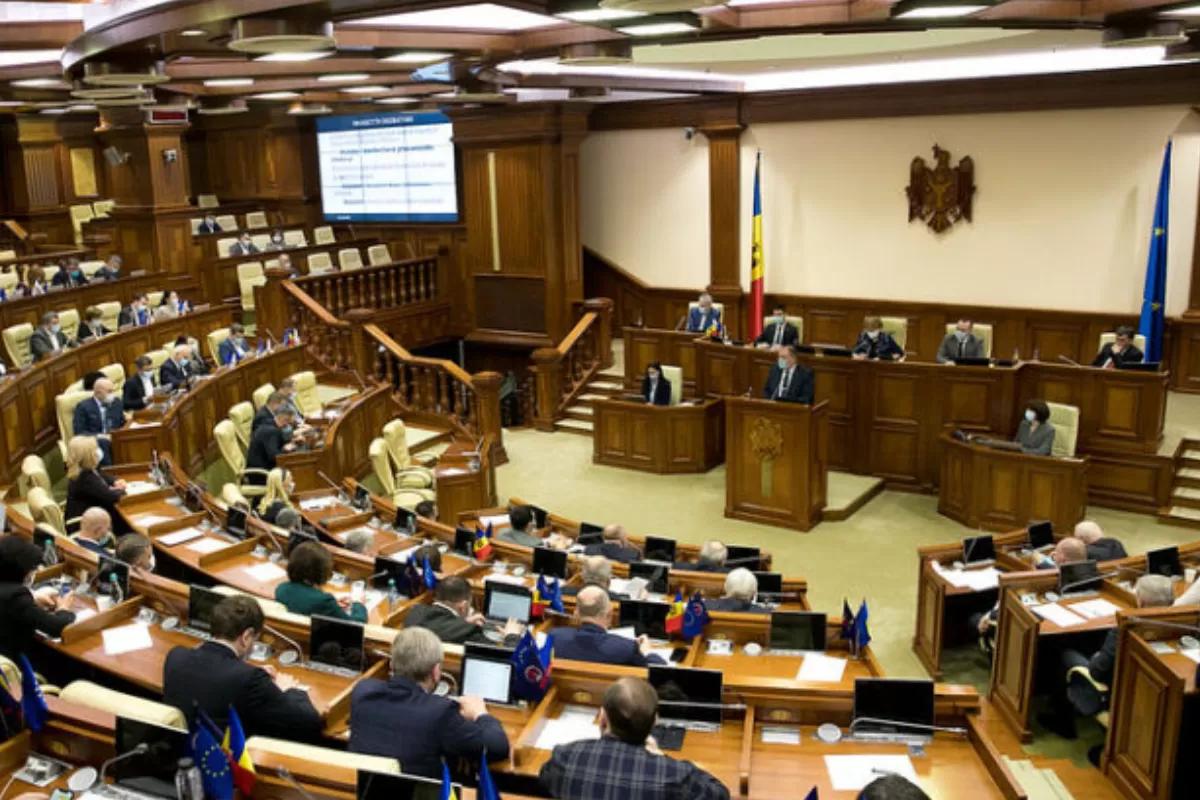
In the Republic of Moldova, two attempts to appoint a new government have failed and more than three months have passed since the resignation of the previous one, so, at least in theory, the conditions have been met for the dissolution of Parliament and for holding snap elections, which all the parliamentary parties said they wanted. But, as usual, in the Republic of Moldova black is never just black, and white is blindingly white.
Snap elections, needed after Parliament lost legitimacy
The first step towards holding snap elections was taken by the Prime Minister supported by the Socialists, Ion Chicu, who on December 23, one day before Maia Sandu took over the presidency, announced his resignation. Chicu was accompanied by the Socialist leaders: Igor Dodon, on the last day of his term as president of the country, and Zinaida Greceanii, the Speaker of Parliament and the nominal leader of the Socialists while Dodon was head of state. Together, the three explained that the purpose of Chicu's resignation was exactly to call snap elections.
The main reason why most important political actors in Chisinau say they want elections is that parliament has lost its legitimacy. First of all, the current legislature resulted from maneuvers by the oligarch Vlad Plahotniuc (who’s fled the country in the meantime, but who at the time was the most powerful man in Moldova), who imposed a mixed electoral system meant to benefit the Democratic Party. Secondly, Parliament’s political structure has changed a lot from the initial one. Three parties managed to score above the minimum threshold required to enter parliament, but now the legislature is divided into six parliamentary groups. First, the NOW Bloc, made up of Maia Sandu's Action and Solidarity Party (PAS) and the DA Platform, led by Andrei Năstase, has split into two distinct factions that usually vote together, but that does not stop them from being opponents too. Then, the Democratic Party, after Plahotniuc's flight, in June 2019, was left with only 11 deputies out of the 30 who initially made it to Parliament. Some of those who left have formed the Pro-Moldova Party, and another group, together with the Shor Party (led by the politician Ilan Shor, the main suspect in the bank theft case), formed the parliamentary platform "For Moldova". There were many suspicions that the deputies had been bribed (by Plahotniuc and Shor) to leave PDM.
Another reason - which some politicians would rather not talk about - is that the balance of power has changed a lot since two years ago, when parliamentary elections were held. Maia Sandu's victory in the November 2020 presidential election raised PAS’s rating, and now, according to some polls, the party could win parliamentary majority on its own.
Despite statements in favor of snap elections, only PAS wants them
In the last two years, there have been several coalitions in Parliament. Currently, after PDM left the government in November 2020, there is a majority formed by the Socialists together with the "For Moldova" Platform and the Shor Party. It is a rather toxic alliance for the Socialists, given the association with representatives of the two fugitive oligarchs. However, Dodon needs the two parties in order to maintain control over Parliament, the Government and some institutions.
Maia Sandu's PAS has 15 deputies out of 101 in Parliament who have practically isolated themselves from all the other parties by insisting on calling snap elections. Thus, Maia Sandu is currently facing a Parliament that is almost entirely hostile to her, and an outgoing Government with reduced powers and responsibilities, which is controlled by the Socialists anyway. As for the state institutions, most are headed by people proposed by the Socialists or individuals left behind by the former PDM government. It is normal to want early elections in this situation. And it's normal for everyone else to oppose it.
This became visible immediately after the resignation of the Chicu Government. One by one, all the other parties have taken a step back, and the predominant discourse now is to vote for a Government with full powers, to get the Republic of Moldova out of the crisis (which has proved to be an impossible mission in the last 30 years), to vaccinate the population, and then hold snap elections.
Even Igor Dodon, who on December 23, together with Ion Chicu, was talking about early elections, after only two weeks started looking for solutions so that they would not be held.
Why did the Chicu government resign if Dodon does not want snap elections? It's not very clear why. One scenario would be that Dodon lost control over Chicu: the resignation was the prime minister's personal decision, taken due to the crisis and the scarce budget resources. A second scenario says that the Socialists want to hold Maia Sandu accountable for calling snap elections in conditions of epidemic and economic crisis, so that she loses the support that the electorate has given her.
Games at the Constitutional Court
The Constitutional Court of the Republic of Moldova is an institution that discredited itself a lot during the PDM government, adopting controversial decisions that were to the liking of the Plahotniuc regime; some were downright hilarious, like that interpretation that three months means 90 days. After the Democrats left, the members of the Court resigned and were replaced by people close to the PSRM, PAS and the DA Platform. PSRM was the dominant force for a while, but after the dismissal of the President of the Court, Vladimir Turcan, in May 2020, the Constitutional Court became the first institution no longer controlled by the Socialists, which was one first sign of weakness on the latter’s part. The court is currently divided.
This divided court has been the main battleground in recent months. Both camps have filed complaints; in some cases, the pro-Europeans have won, in others the Socialists and their allies have been the victors.
After the resignation of the Chicu Government, Maia Sandu appointed Natalia Gavriliță, a member of her team and former Minister of Finance, for the position of Prime Minister. Maia Sandu's message to Parliament was not to vote for the government and, indeed, the government did not get any votes. On the same day, however, the Socialists and their allies proposed the candidacy of Mariana Durleșteanu, also a former Minister of Finance in 2008-2009
According to an earlier ruling of the Constitutional Court, the president is obliged to designate the candidate for prime minister who enjoys the support of a parliamentary majority. However, Maia Sandu refused to appoint Durleșteanu, citing integrity issues in the case of several deputies who signed the proposal, and re-appointed Natalia Gavriliță. The Socialists complained to the Court, which ruled in their favor. It seemed that Maia Sandu had only two options left - either she violated the fundamental law, or she gave in. The solution came from Mariana Durleșteanu, who announced on Facebook that she no longer wanted to run. The news seems to have caught even Dodon off guard, who didn't know what to say. Shortly afterwards, Maia Sandu appointed Igor Grosu, the interim president of PAS, for the office of prime minister. Obviously, the Socialists challenged the decree at the Court again. The judges, however, ruled that the constitutional norm had been observed. The Socialists did not give up though: after denouncing pressures to which Mariana Durleșteanu was allegedly subjected, they announced that they had a new proposal - the former PSRM deputy Vladimir Golovatiuc, currently ambassador to Moscow, a man who practically does not speak Romanian at all. The attempt to appoint the Grosu Government failed, after the parliamentary majority boycotted the sitting. On Friday and Monday, Maia Sandu held again consultations with the parliamentary groups, which, with the exception of those from PAS, are against snap elections. Moreover, a political statement by Parliament against its dissolution was adopted on Friday. However, Maia Sandu announced on Monday evening that, in her opinion, the legal circumstances for dissolving Parliament had been met and she notified the Constitutional Court in that regard. As in the Republic of Moldova, black is never just black, and white is always extremely white, things can get complicated at this moment, even if, theoretically, the process has already entered the procedural stage and there should be just one more step to snap elections. It all starts with a recent interpretation by the same Constitutional Court, according to which the parliamentary majority can address the issue of appointing a new government even during consultations with the head of state on the dissolution of Parliament. In the Socialists’ opinion, this means that since there is a majority in parliament that supports the formation of a government, there are no grounds for dissolving it, even if the deadline for appointing a new executive has been exceeded.
The spectrum of a political war of attrition
The Socialists seem to have adopted a logic of confrontation. They accuse Maia Sandu, accuse the Court, insist on the candidacy of Vladimir Golovatiuc, say they will not accept elections if several hundred thousand people are not vaccinated - though Igor Dodon, as president, was rather skeptical about the pandemic, and the Chicu government did nothing to provide vaccines or money to buy them, so the Republic of Moldova was the last country in Europe to start the vaccination campaign, and so far, not even all doctors have been immunized.
Another threat from the Socialists’ camp is that they will block the allocation of money for elections, as the 6-million-dollars must be approved by parliament.
Theoretically, elections could be held two months after the Court rules that the conditions have been met. According to opinion polls in recent months, PAS is the favorite, but it is not certain that it will secure a parliamentary majority, nor is it known whether it will have anybody to form a coalition with. The DA platform, which would be the most natural ally of PAS, is unlikely to enter Parliament, unlike the PSRM, the Shor Party and possibly Our Party, led by the controversial politician Renato Usatii, the mayor of Balti, with connections in The Russian Federation and, as the press wrote, even in the Russian underworld. In the second round of the presidential election, Usatii urged his voters to vote for Maia Sandu, and this call probably played an important role in her victory. However, a potential political governing alliance between the two parties, which would affect the ratings of both, even if it is formed, is unlikely to last.
Most likely, the trench warfare will continue. Even if the Constitutional Court judges decide that the conditions for dissolving Parliament have been met, the Socialists will get in the way and try to postpone the elections in order to gain time and reduce the popularity of Maia Sandu and PAS, respectively. The declaration of a state of emergency fits perfectly into this logic. Parliament cannot be dissolved during the state of emergency, and the administration of state affairs falls under the responsibility of a Commission for Exceptional Situations, in which the lion's share belongs to the Government representatives. The declared for up to 60 days, may be extended. Thus, in a few steps, snap elections can be postponed until autumn, as Igor Dodon intends. Meanwhile, the Socialists have also filed a complaint at the Constitutional Court claiming that there are no reasons to dissolve Parliament. However, it is expected that Maia Sandu will refuse to designate the PSRM candidate for prime minister, even if the Court decides that consultations with the parliamentary majority must continue. Maia Sandu may be suspended by Parliament for her refusal, but that requires two-thirds of the votes. The suspension should also be followed by a referendum, in which, as the current conditions are, it is unlikely that Maia Sandu will be dismissed.
Street protests could also be staged, by one camp or the other. Or by both, simultaneously ...
It is possible that all this will last at least another half a year or, depending on the political situation and the fluctuations in parliament and polls, to go on as far as 2023, when elections have to take place anyway. This would no longer be a surprise in a country that didn’t have a president for two and a half years, also because of political confrontations, and where politicians, when they decided to join efforts, managed to steal one-eighth of the country’s GDP in just a few weeks.