The cartoon is called “Middle East explained”. It shows two men, the one of the left wearing a hoodie, the one on the right a military helmet. Both hold out their guns pointed at each other. Above the former there’s an inscription reading “Hamas”, although the flag shown in the upper-left corner and the on his shoulder pad is Palestine’s, not Hamas’s. The inscription above the latter reads “Israel”. The Hamas militant crouches behind a stroller. The Israeli soldier stands in front of another stroller, identical to the first. The message is clear: Palestinians are terrorists who use their children as human shields, while the Israeli defend theirs. The cartoon is but an instance of dehumanizing the enemy, a tactic probably as old as war itself.
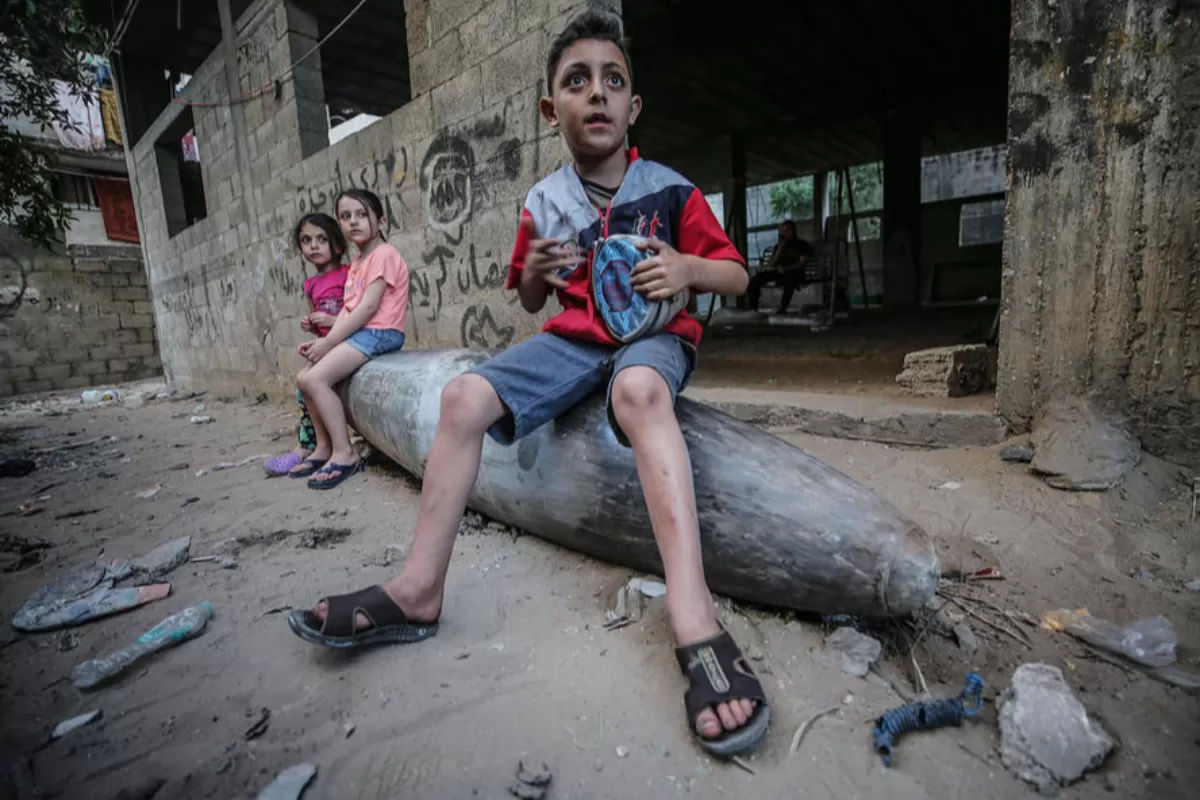
The cartoon is in stark contrast with the dozens, maybe hundreds of images that have been flooding the media over the years, and more particularly in recent days, images of children killed in air raids. I recall one particular photo, taken during another conflict pitting Israel against Hamas. It was taken in front of a hospital, showing a young father, holding the lifeless body of his daughter covered in lime dust. The man’s face is twisted with grief and despair. That is the hard reality.
Dehumanizing the enemy is common practice for both sides. A while back, I had a talk with a Palestinian who complained about the reality on the ground, and was trying to make a point that Israel was a murderous state. It was back when Palestinian terrorist cells were regularly orchestrating suicide bomb attacks against the Israeli civilian population, so I told him these were acts of murder as well. He denied, saying that all Israelis, men and women alike, are forced to enroll in the military (which isn’t actually true), which meant that all the victims of terrorist attacks were in fact military, despite wearing plain clothes. I told him the attacks killed not just men and women, but children too. He said those children were going to be raised as future soldiers, thus making them legitimate targets. My interlocutor wasn’t part of any political movement, he wasn’t some religious fanatic; on the contrary, he was quite a secular man, less conservative than most Arabs I’d met. He was, however, incapable of showing empathy to others, of seeing the pain and desperation in the tens and hundreds of photos pouring in from Israel. That is how hatred works.
A local once told me that, once the last bullet has been fired, it would take a whole generation before there could truly be peace between the Israelis and the Palestinians. For one, there’s been just too much bloodshed. Too many families have lost dear ones to a conflict spanning decades. It takes time for the wounds to heal. And it’s going to be a long time before the last bullet is fired.
After 11 days of fighting, Israel and Hamas have reached a ceasefire agreement that solves nothing: it’s just a short break until the new round of clashes beings.
The situation in Gaza remains unchanged. It’s an enclave that has been subject to terrestrial and maritime blockades for the last 14 years, ever since Hamas took control after driving out Fatah. In times of relative peace, it’s hard to get in and out of the country; and whenever tensions escalate, it’s virtually impossible. The Gaza Strip is an open-air prison. I went to Gaza a few years ago, as part of a small group of journalists. A crammed-up state, streets swarming with people, cities shrouded in darkness (power cuts have become routine). The people here lack any future prospects, traumatized by past conflicts, knowing the phone might ring one night, the voice of an Israeli officer telling them they have five minutes to evacuate the building. And then there’s Hamas, whose very name inspires dread in people. You can often hear them whispering about its activity: that’s the house where their leader lives, that guy who came to ask what you were doing in the refugee camp is probably spying for them, that guy over there crossing the road must be one of their fighters, etc. Hamas describes itself as a resistance movement fighting for and representing the people. Except that it isn’t. It’s a terrorist organization that seized power by force and exerts it by its own will, like any dictatorship.
The situation hasn’t changed much in Jerusalem either. For Israel, the city will always be its eternal and indivisible capital. Palestinians also regard it as their capital, and won’t give up the eastern districts, which also include the old city, harboring the holy sites. Every stone, every gesture, every decision matters in Jerusalem. The Second Intifada started after Ariel Sharon visited the Temple Mound. The biggest clashes in recent years between Palestinian protesters and Israeli security forces occurred after Donald Trump announced he was moving the United States Embassy to Jerusalem, and later when the move was actually operated. The most recent string of violence started in Jerusalem. The situation grew tense amidst disputes over property rights and certain restrictions imposed by the authorities. When violence broke out on Temple Mound, Hamas launched the first missiles. Many pundits saw their decision as an attempt to take over the fight for Jerusalem from the Palestinian Authority, and, to a great extent, they are right to do so. An election will sooner or later be held in Palestinian territories. It was originally slated for May 22, but Mahmoud Abbas has postponed the election indefinitely, particularly due to the developments in Jerusalem. When an election is eventually held, Hamas will need votes. After years of ruling Gaza with an iron fist, with little to no success in improving the situation on the ground, it needed something to reaffirm its legitimacy and breathe new life into the resistance movement there. But beyond the political analysis, we also need to factor in religion as well – Hamas is, after all, an Islamist organization, and there’s no incentive more appealing to Islamists than the holy places of worship.
The situation is unlikely to improve in occupied West Bank either. The Palestinians are basically held hostage in a number of enclaves along the roads tying Israel to the settlements. The settlers too are trapped in enclaves, protected by their armies, surrounded by the mass of Palestinians. The legitimacy of Mahmoud Abbas’s government is wearing thin.
There’s hardly still any talk of peace negotiations and a resolution of the conflict, ever since Donald Trump’s unfortunate peacemaking plan. As long as the waring camps refuse to sit down and talk, it’s hard to imagine a resolution that will solve the three big issues that blocked the peace process in Oslo: the Palestinian right of return, the status of Jerusalem and the West Bank settlements.
***
In 1996, Benjamin Netanyahu took power for the first time at the end of an election campaign with populist undertones, which focused on fear tactics: he had accused his opponent, Shimon Peres, one of the architects of peace, alongside his superior and friend, Yitzhak Rabin, who had been assassinated by an Israeli fanatic in 1995, that he would hand over Jerusalem to the Palestinians. The circumstances were very delicate at the time, considering Hamas, who had been opposing the peace process, had started planning suicide attacks on the Israeli civilian population.
Twenty-five years later, Hamas claimed victory after another few hundred Palestinians, including 65 children, were killed in a war it started, despite having no chance of winning it. On the other side, if there’s one true winner, that will be Benjamin Netanyahu, who two weeks ago was on the verge of losing power; now, whatever opposition had been building up against him is gone.
Hamas and Bibi are the winners of the ceasefire agreement. True peace will have to wait.