26 years after the end of the Balkan war, marked the Dayton Peace Accords, the Croatian-Muslim Federation of Bosnia and Herzegovina and Republika Srpska are about to break up again.
Bosnian Serbs ready to break away from Bosnia so as not to admit past crimes
In order to understand what is happening in this former Yugoslav republic, we must start from highlighting the three pillars on which the existence of this Federation is based:
- Power is divided between the representatives of 3 ethnic groups: Croats, Bosnian Muslims and Bosnian Serbs
- Ensuring the security of all citizens
- The ability to use the constitutional framework to strengthen state institutions, in order to build a stronger state
The High Representative, a position established under the Dayton Accords, is the one who makes sure that the state institutions are functional and is mandated by the International Community to intervene in case of violations of the Dayton Accords.
With the laws passed in the local parliament of Republika Srpska, under which Bosnian Serbs are pulling out from the state's central institutions, a new secessionist chapter has been opened.
All these years, Bosnian Serbs have recognized neither the authority of the High Representative for Bosnia and Herzegovina nor the form of organization of the Federation, as evidenced by the above-mentioned accords which have been the Constitution of this small, poor and corrupt country for 26 years. In the nearly three decades since the end of the bloody war of secession, there have been many Bosnian Serb outbursts. However, all of them have been kept under control by the United States and the European Union, which supported the Federation's economy.
The wounds inflicted by Bosnian Serbs in the 1995 Srebrenica massacre, when 8,000 Muslims, boys and men, were killed, have not yet closed. In fact, the actions carried out by the nationalists in Banja Luka, the capital of Republika Srpska, had been mostly declarative, until this summer when the so-called Inzko law was adopted at Federation level. It’s actually a string of amendments to the Criminal Code that sanction the denial of genocide and the glorification of war criminals. Why was this law needed? Valentin Inzko, the former High Representative for Bosnia and Herzegovina, defended the adoption of the amendments as a necessary means to remedy the injustice to the citizens of that country, many of whom are still waiting to identify their loved ones in the Srebrenica mass grave.
“The citizens of Bosnia and Herzegovina have waited many years for their elected representatives to legislate this very serious issue. However, every effort to do so was blocked! During that time, the situation has gotten worse, and is now getting out of hand! By advancing various conspiracy theories, some political leaders are openly praising the finally convicted war criminals, denying that the Srebrenica genocide ever took place, while some ordinary citizens are following their cues and narratives”, said the Austrian diplomat Valentin Inzko at the end of his term as High Representative.
What do the High Representative's changes say? They stipulate a prison sentence of 3 months to 3 years for those who publicly incite violence or hatred against a group of people or a member of a group determined by ethnicity, race, color, religion, origin or nationality. Imprisonment from 6 months to 5 years is also provided for those who publicly approve, deny, brutally diminish or try to justify genocide or any crime against humanity or war crime.
In other words, it incriminates the entire rhetoric of some Serbian parties in the last 10 years and of the leader of the Bosnian Serbs, Milorad Dodik, in particular. Of course, the adoption of these changes was followed by the Bosnian Serbs boycotting the state institutions.
Putin and Xi, the Bosnian Serbs’ best friends
But the Banja Luka parliament did not stop there. In mid-December, it launched a controversial process of withdrawal from the central institutions, the army in particular, ignoring Western warnings about separatist intentions in this ethnically divided Balkan country. The Bosnian Serb parliament gave the government six months to organize a withdrawal from three central institutions: the army, the judiciary and the tax administration.
“I am not a Serb isolationist, I want not only a better arrangement for Republika Srpska, but also for Bosnia and Herzegovina,” Dodik said in the Banja Luka parliament , adding that “if we do not solve the current challenges, there is a danger that Bosnia and Herzegovina will fall apart and Republika Srpska will step aside.”
The Republika Srpska Parliament also endorsed the Declaration on Constitutional Principles. This document calls on the government of the Serbian entity, in coordination with President Milorad Dodik, to draft the text of the Constitution of Republika Srpska, which will set out all the powers of the Republic.
These are steps that lead to escalating tensions in this country where, against the backdrop of poverty and lack of perspective, the nationalist fire has been smoldering for years.
What is interesting is the moment when Milorad Dodik has decided to move from words to action, knowingly violating the Dayton Accords, and therefore the Constitution of the Federation. It is the moment when Vladimir Putin is blackmailing the whole of Europe with gas supplies and keeps everybody’s nerves on edge with a massive deployment of forces on Ukraine's border. It is no secret that the Russians are Alexander Vucic's loyal partners in Serbia, who support Dodik in dreaming of Greater Serbia. And it is the moment when the American and Chinese bayonets are getting dangerously close to a fiery duel. Or Milorad Dodik makes no secret of the partnership with Moscow and Beijing, defying any threat of sanctions from both the EU and the US .
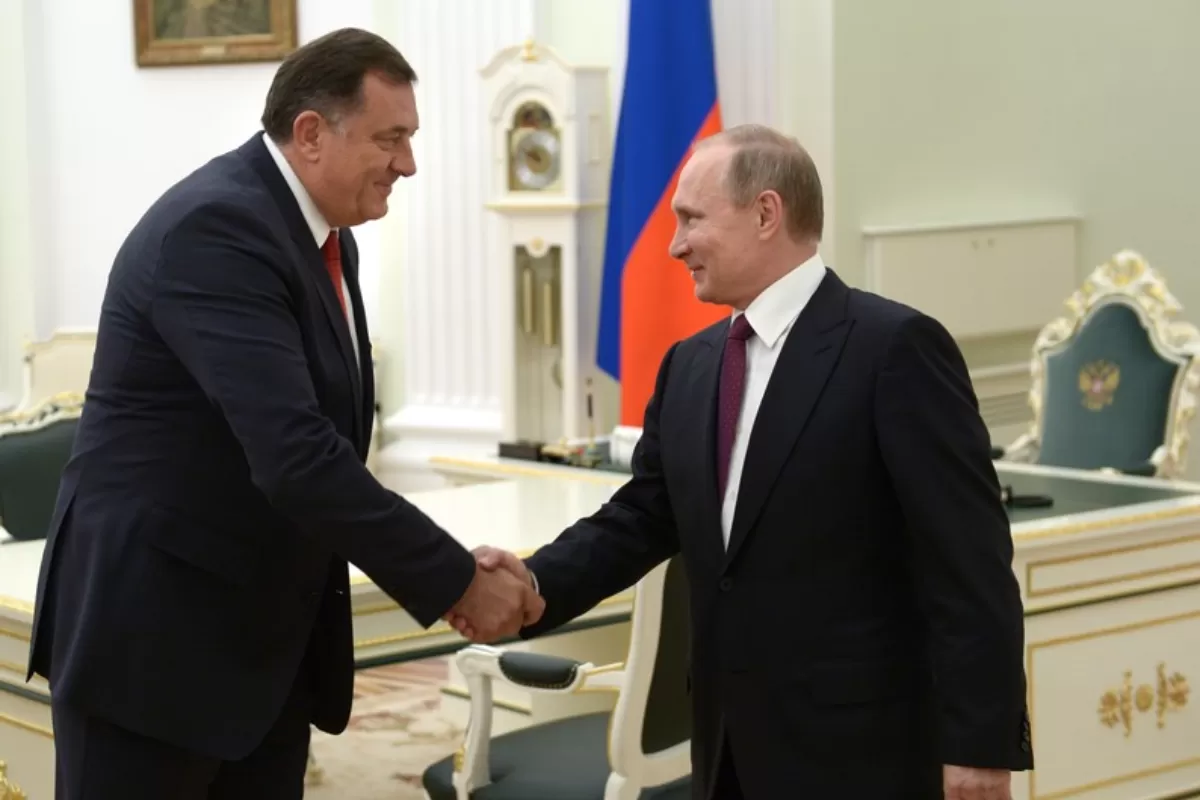
“When I go to Putin, he doesn't ask for anything. He just says: How can I help you? No matter our conversation, I have never been fooled ... Same with Xi Jinping: what can I do for you?” Dodik said in an interview with The Guardian reporters.
A Russian diversion in Bosnia?
I can't help but notice that Milorad Dodik's first secessionist attack coincides with the EU's extension of sanctions on Russia following the annexation of the Crimean Peninsula. In the summer of 2017, the European Council took this decision after finding that Moscow was not complying with the Minsk ceasefire agreements. In the same year, Dodik was banned from traveling to the United States and gaining access to his assets following the Republika Srpska National Day referendum. There will also be specific sanctions from the European Union, directed at Dodik and his political supporters.
Coming back to the secessionist aspirations of the Bosnian Serb leader. It’s true that Milorad Dodik's proposals were adopted by the Banja Luka parliament. Not by an overwhelming majority, though. Of the 80 seats, only 52 percent agreed with the withdrawal from the central institutions. In other words, not all Serbian parties want to break away from Bosnia at all costs, but rather wait for the European Union's move, which could close the file with a new wave of enlargement, which would be a stretch. But this is a time-consuming process. In 2016, when Bosnia and Herzegovina began accession negotiations, the European Union imposed radical reforms - from the judiciary to the electoral law, and progress has been insignificant. In other words, Dodik is and will be the perfect agitator to play the interests of Bosnian Serbs in the Russian roulette, but the bullet is aimed at Republika Srpska.
I believe that, one way or another, the year 2022 will be decisive for this former Yugoslav republic in terms of the general elections due this autumn. Secessionists will have enough time to trouble the waters, to play hard the nationalist card, and capitalize on the frustrations of the people living on the brink of poverty. And this is true throughout the Croatian-Muslim Federation. The greater the chaos, the greater the risk of Bosnia's getting split. Moreover, it should not be overlooked that the Russians would be rather happy with a conflict in the heart of Europe, which has already been disrupted by two very long pandemic years.