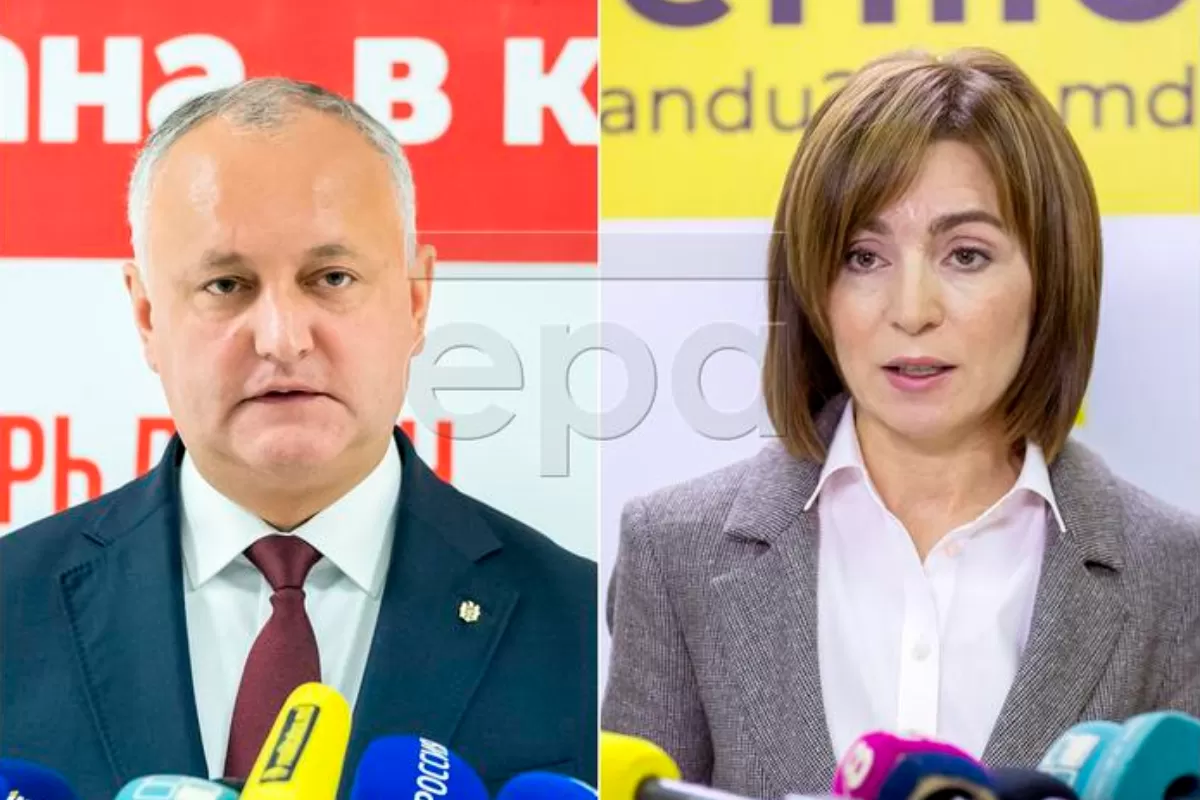
In my previous editorial for Veridica I wrote about former president Igor Dodon, the current leader of the Party of Socialists in the Republic of Moldova (PSRM), the largest party in the Moldovan Parliament, and his desperate attempts at clinging to power, much like his predecessors. It was only a matter of time before Dodon moved from theory to practice. Therefore, at the end of last week, on Friday more precisely, while on a visit to Moscow, Dodon mounted a fierce attack on the rule of law, namely on the Constitutional Court in Chișinău.
First of all, the Party of Socialists, together with Shor Party and a few MPs from the For Moldova group voted a political resolution condemning the Constitutional Court’s “usurpation of power”.
Dodon and Shor were extremely bothered by the fact that the Court had recently issued rulings in favor of dissolving Parliament and the organization of early parliamentary elections.
Dodon made every attempt at linking the image of wanted millionaire Vlad Plahotniuc, who controlled all state institutions in the 2015-2019 period, including the Constitutional Court, to the current president Maia Sandu, whom he accuses of pulling the Court’s strings.
Dodon went even farther: he tried to replace the Constitution, which the Constitutional Court safeguards and protects, with the legislative power he controls, all in an attempt to trample the balance of state powers. Dodon and his fellow MPs in Chișinău therefore voted a law on dismissing the president of the Constitutional Court of Moldova, Domnica Manole.
Alternate realities: politics above the law
Worth noting is that Domnica Manole had been appointed by PSRM in the summer of 2019, shortly after the demise of the Plahotniuc regime and the formation of the PSRM-PAS ruling “coalition”. Right now, the same PSRM have decided to replace Manole and have mounted an attack on the Constitutional Court, claiming that Parliament is the institution representing the will the people.
The Socialists carried out their blitzkrieg according to a well-devised plan. First, PSRM and its allies voted a political resolution regarding the usurpation of power by the Constitutional Court and pushed a vote of no-confidence for three of the Court’s five judges.
Then they voted a second resolution revoking the president of the Constitutional Court, Domnica Manole.
However, Article 137 of the Constitution of the Republic of Moldova clearly stipulates, with no room for interpretation, that Court judges are immovable. More precisely, they cannot be dismissed during their term in office. Similarly, Article 9 in the Constitution also states that a Court judge can be replaced only in the following exceptional circumstances: health problems exceeding the course of four months, violations of the oath and obligations deriving from their office, sentences for crimes or incompatibility.
Yet all these provisions have nothing to do with the political reasons mentioned by Dodon, who is unhappy with the Court’s recent rulings.
Dodon pulls a pro-PSRM judge out of his hat
The plot thickened swiftly and public opinion came to realize that this is a carefully designed and spaced-out plan to usurp state power. After the hasty revocation of Domnica Manole, the Socialists then voted in one of their close associates, Boris Lupașcu, a lawyer and former head of department at the Prosecutor General’s Office. In 2019, Lupașcu was vying for the position of interim Prosecutor General.
After Lupașcu was sworn in, things got serious, and the political joke of PSRM and Dodon took a rather complex turn.
President Maia Sandu went public, urging people to defend state institutions. On Friday afternoon, Sandu summoned the Supreme Security Council and called on the heads of power structures to make sure constitutional order is observed and protect state institutions in the case of an attack.
In turn, the EU and US embassies in Moldova conveyed firm messages that such oversights and attacks on the rule of law have to stop immediately. People took to the streets and protested in front of the Constitutional Court building. President Maia Sandu told the public television station on Friday evening that she has called on the state’s institutions to prevent a possible destabilization and urged the Moldovan population to mobilize in order to support the organization of early parliamentary elections as soon as possible.
Following Friday’s events, Maia Sandu now wants to accelerate this process, since Igor Dodon and his cronies have showed they consider themselves above the law and will no longer observe the rule of law, ready to stir up mass unrest.
“According to its current prerogatives, Parliament cannot sack a Constitutional Court judge. This unconstitutional vote was followed by another action against the Constitution, an attempt to appoint a new Constitutional Court judge. There are certain deputies in our Parliament who certainly don’t want to end up being judged by the people”, Maia Sandu said on the Good Evening show on the public television.
Restoring order and consequences
Dodon’s blitzkrieg on the Constitutional Court ended on Friday evening, after the Court suspended Parliament’s decisions to revoke Domnica Manole and have her replaced with Boris Lupașcu.
Yet this pollical pandemonium staged by the Socialists and their allies cannot go unpunished, not morally or legally. Moreover, these actions are punishable as attempts to usurp state power, since no politician is above the Constitution. There’s no democracy where the legislative power supersedes the judiciary.
Furthermore, Maia Sandu has called on the Prosecutor General’s office to step in and launch an inquiry in this matter. “I have called on the state’s key institutions to steer clear of any attempt at involving them in the enactment of unconstitutional and unlawful orders, but to safeguard constitutional order, including the security of Constitutional Court judges. I have also called on the Prosecutor General’s Office to investigate Parliament’s recent decisions and ascertain the extent to which these actions can be labeled as an attempt to usurp state power”, Maia Sandu said.
After his failed attempt at taking political control over the Court, Dodon tried to convince the public that they merely wanted to see if Maia Sandu’s followers would act just like Plahotniuc’s voters, who set up tents in front of state institutions in order to guard them.
Two PAS deputies on Saturday filed a notification with the Prosecutor General’s Office, calling for an investigation into Dodon’s attempt at usuring state power. This time we’re no longer talking about a political action, but a premeditated attempt at violating the law and attacking state institutions and the rule of law.
Stakes and imminent outcome
PSRM’s awkward attempt at commandeering the Constitutional Court will exact a heavy toll on the party’s approval rating ahead of the upcoming early parliamentary election, which is inevitable and can no longer be postponed, no matter how many tricks the current lawmakers in the Republic of Moldova are willing to pull.
On the short and medium term, this political stunt did more harm than good, offsetting Saturday’s boost to PSRM’s reputation after Moscow sent Moldova 140 thousand Sputnik V vaccines, after months of repeated requests and visits.
As to how the early election saga will end, there’s only step left. On April 28, the Constitutional Court is expected to issue a ruling on the final notification that stands in the way of early elections, namely the one referring to the lawfulness of the state of emergency in the Republic of Moldova, declared on April 1 for two months. Maia Sandu said that, in the event of a favorable ruling, she would immediately dissolve the current Parliament, one of the most unpopular in the history of Moldova.
It’s highly likely Constitutional Court judges will rule against the lawfulness of this measure, which de facto produced little change in Chișinău, thus reducing it to a heavy-handed attempt at postponing the dissolution of Parliament. The Socialists used the state of emergency to serve their political interest, since the law clearly stipulates Parliament cannot be dissolved during the state of emergency, which PSRM seemingly would have wanted to continue forever.
This assault on the rule of law, particularly on the Constitutional Court, could result in criminal investigations for Dodon and his cronies. It’s all in the hands of Prosecutor General Alexandru Stoianoglo, and we’ll see if prosecutors will do their job, or impunity will prevail once more in the Republic of Moldova, the way it has for the past 30 years.
This isn’t the first time Dodon has tried to bypass the law. A similar show of force was seen shortly after Dodon stepped down after losing the presidential election of November 2020. In mid-December last year, Dodon and PSRM orchestrated another blitzkrieg in Chișinău, tried to push a law package writing Russian propaganda a blank cheque, transferring the Security and Intelligence Service from the Presidency to Parliament’s authority and making Russian an official language of communication in the Republic of Moldova. In the end, the Constitutional Court ruled against these laws.
In early 2021, Dodon agreed to holding early election, but quickly changed his mind after his approval rating went down in opinion polls. He then tried to block early elections and shift the blame for the health crisis in the Republic of Moldova on Maia Sandu’s shoulders, who is also the image of the Action and Solidarity Party (PAS). The purpose was to weaken PAS’s lead in the polls ahead of the early parliamentary election.
It remains to be seen if prosecution authorities will pass this challenging test and take a firm stand against politicians in the Republic of Moldova, who frequently and deliberately violate the law.
Until then, the rule of law remains a fragile concept in Chișinău, which Moldova’s heavyweights will always trample under their feet without being held accountable.